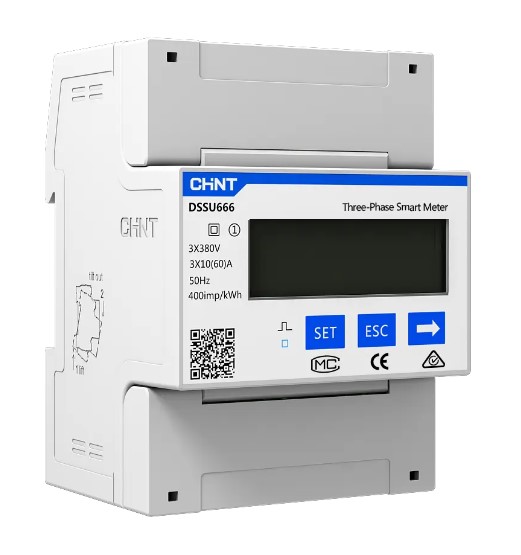
Chint DSSU666 Energy Meter 3-phase
Content languageEnglish
Description
Type DSSU666 three phase electronic energy meter (din-rail) is designed based on power monitoring and energy metering demands for electric power system, communication industry, construction industry, etc. as a new generation of intelligent instrument combining measurement and communication function, mainly applied into the measurement and display for the electric parameters in the electric circuit including voltage, current, power, frequency, power factor, active energy, etc.
Complied standards: IEC62052-11 "Electricity metering equipment(AC)-General requirements, tests and test conditions- Part11:Metering equipment IEC62053-21 "Electricity metering equipment(AC)-Particularrequirements-Part21: Static meters for active energy(classes 1 and 2)" MODUS-RTU protocol.
Can also be used for DTSU666, the only difference is that the Byte Order checkbox must be selected for all the sensors.
From feedback from users you might try without the byte order checked first.
(Should also work for DSSU666-H and DTSU666-H as this has the same parameter list. This is not tested.)
Inputs and outputs · 28
| Name | Type | Unit |
|---|---|---|
| Voltage L1-L2 | Modbus | V |
| Voltage L2-L3 | Modbus | V |
| Voltage L3-L1 | Modbus | V |
| Frequency | Modbus | Hz |
| Current L1-L2 | Modbus | A |
| Current L2-L3 | Modbus | A |
| Current L3-L1 | Modbus | A |
| Voltage N-L1 | Modbus | V |
| Voltage N-L2 | Modbus | V |
| Voltage N-L3 | Modbus | V |
| Active Power Combined | Modbus | W |
| Active Power L1 | Modbus | W |
| Active Power L2 | Modbus | W |
| Active Power L3 | Modbus | W |
| Reactive Power Combined | Modbus | var |
| Reactive Power L1 | Modbus | var |
| Reactive Power L2 | Modbus | var |
| Reactive Power L3 | Modbus | var |
| Power Factor Combined | Modbus | <v.1> |
| Power Factor L1 | Modbus | <v.1> |
| Power Factor L2 | Modbus | <v.1> |
| Power Factor L3 | Modbus | <v.1> |
| Import Total Active Energy | Modbus | kWh |
| Export Total Active Energy | Modbus | kWh |
| Total reactive energy of the first quadrant | Modbus | kvarh |
| Total reactive energy of the second quadrant | Modbus | kvarh |
| Total reactive energy of the third quadrant | Modbus | kvarh |
| Total reactive energy of the fourth quadrant | Modbus | kvarh |
FAQ
No questions have been answered yet.
Questions and answers
compatibility with solax inverters?
OpenIs this 3-phase meter integration also compatible with Solax inverters? The Solax 3-phase meter looks identical and also has the product ID DTSU6666. I'm curious if I can integrate a Solax X3-MIC G2 12KW with this DTSU666 smart meter integration into our loxone system. Thanks for any help. Jan
1 reply
Hi Jan, I guess this should be compatible, as long as it's the same product ID. BR eirik
DTSU666
OpenDanke für die Vorlage, allerdings ist zumindest beim DTSU666 bei allen Registern noch der Haken Registerreihenfolge zu setzen. Ansonsten kommen nur komische Werte raus. Schönen Gruß Thomas
1 reply
Hi Thomas, I will add a comment for the DTSU666, So that the register order checkbox must be selected for all the sensors.
Through Modbus TCP
OpenHello, unfortunately, I can't get the meter reading to work. I am using a Modbus RTU to TCP adapter with the following settings: baud rate 9600, data size 8 bits, parity none, stop bits 1. Loxone is reading some data, but it is not correct. What could be wrong?
No replies
Through Modbus TCP
OpenHello, unfortunately, I can't get the meter reading to work. I am using a Modbus RTU to TCP adapter with the following settings: baud rate 9600, data size 8 bits, parity none, stop bits 1. Loxone is reading some data, but it is not correct. What could be wrong?
No replies
Register Order Not Required
OpenOn my setup (DTSU666 + Loxone RS485 Extension), enabling the “Register order” option did not work. It resulted in incorrect/garbled values.
2 replies
Thanks for the information. I will add a note in the Loxone library.
I noticed that it was previously updated following a comment from another user suggesting to enable “byte order.” However, this can appear to be correct if the register offset has not been handled properly.
The Loxone RS485 Extension uses 0-based addressing, while many Modbus datasheets (including the DTSU666) use 1-based register numbering. If the register address from the datasheet is entered directly without subtracting 1, the system will start reading from the wrong register.
In this situation, enabling “byte order” may seem to fix the problem, but it is only compensating for an incorrect register offset rather than addressing the root cause.
BR eirik
Log in to rate, comment or ask a question. Log in
Ratings and comments
No ratings or comments yet.
Log in to rate, comment or ask a question. Log in