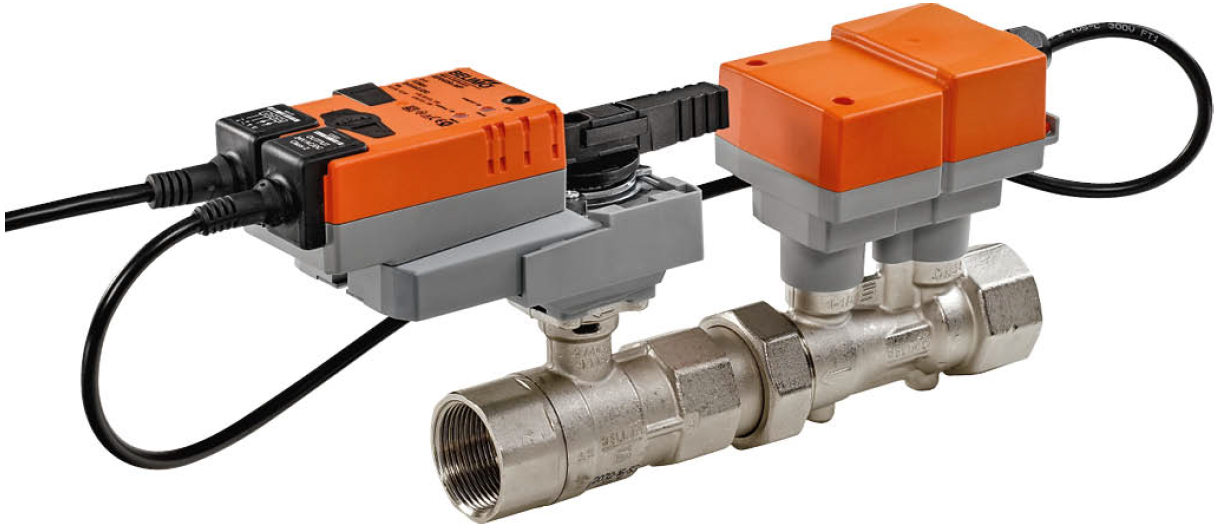
Belimo 2-way EPIV Modbus RTU
Content languageEnglish
Description
• For modulating control of air-handling and heating systems on the water side • For closed cold and warm water systems • Communication via BACnet MS/TP, Modbus RTU, Belimo-MP-Bus or conventional control • Conversion of active sensor signals and switching contacts • Control modulating, communicative, hybrid
Structure:
What is the difference between an EPIV valve and an energy valve?
- The EPIV has no integrated and external temperature sensors - The EPIV does not have MID certification - The EPIV misses Belimo internal functions like "Power Control", "Delta T Manager", "PoE", "Cloud analysis", "Data recording", "BACnet/IP, "Modbus TCP/IP", "Web Server"
The choice of paring Belimo EPIV with Loxone offers the possibility of:
- [Demand based Heating and Cooling]: The EPIV Valve regulates depending on the Room Heating or Cooling requirement, Heating Curve, Presence detection, Window status, Automatic Shading, Weather Forecast and Energy Management (PV Surplus, Variable Electricity Tariffs, Load Management). - [Flow/Power/Energy Monitoring and Analysis]: The integrated Water Flow / Power / Heating & Cooling consumption recording of the Energy Valve ensures transparent Energy Flow Monitoring with individually created System Schematics. Using the Energy Flow Monitor for thermal outputs provides an overview of total and current energies. Energy leaks in the building can be found quickly. The valves that do not close tightly or, for example, consumers that are in “manual mode” are discovered. Using and storing statistics, creating individual notifications. e.g. threshold value excesses or error notifications. - [Application in a hybrid system]: The possibility of application in a Hybrid system or in a system that uses different Energy sources ensures cost independence, a high level of comfort and flexibility in heating and cooling. Facilitates the combination of complex Hydraulics such as multiple base-load heat generators (e.g. Heatpump or Biomass) with Peak-Load Heat Sources (e.g. Oil or Gas). - [Dewpoint monitoring]: The minimum flow temperature can be calculated using a formula building block and controlled with the EPIV valve based on the room temperatures and room humidity. - [Cost Saving]: Fast commissioning via Belimo Assistant and fast error finding thanks to Belimo and Loxone Diagnose Tools.
Inputs and outputs · 26
| Name | Type | Unit |
|---|---|---|
| Actuator Type | Modbus | <v> |
| Relative Position | Modbus | % |
| Absolute Position | Modbus | ° |
| Sensor 1 Value | Modbus | <v.1> |
| Setpoint Analog | Modbus | % |
| Series Number 1st Part | Modbus | <v> |
| Series Number 2nd Part | Modbus | <v> |
| Series Number 4th Part | Modbus | <v> |
| Firmware Version | Modbus | <v> |
| Malfunction and Service Information | Modbus | <v> |
| Relative volumetric flow | Modbus | % |
| Absolute volumetric flow in liter per min | Modbus | l/min |
| Absolute volumetric flow in selected units | Modbus | l/min |
| Nominal volumetric flow in liter per minute | Modbus | l/min |
| Nominal volumetric flow in selected unit | Modbus | l/min |
| Control mode | Modbus | <v> |
| Setpoint | Modbus | % |
| Override Control | Modbus | <v> |
| Command | Modbus | <v> |
| Bus Termination | Modbus | <v> |
| Maximum | Modbus | % |
| Sensor 1 Type | Modbus | <v> |
| Bus Fail Position | Modbus | <v> |
| Timeout for Bus Watchdog in s | Modbus | s |
| Setpoint Source | Modbus | <v> |
| Unit selection flow | Modbus | <v> |
Ratings and comments
No ratings or comments yet.
Log in to rate, comment or ask a question. Log in